
API Freshwater Master Test Kit Review – 800 Tests of Aquarium Peace of Mind
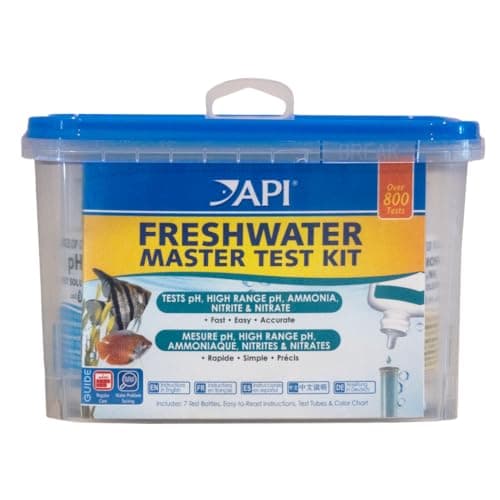
API FRESHWATER MASTER TEST KIT 800-Test Freshwater Aquarium Water Master Test Kit, White, Single, Multi-colored
API
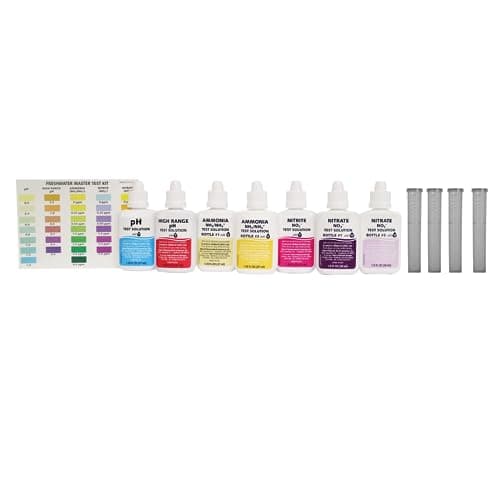
- Contains one (1) API FRESHWATER MASTER TEST KIT 800-Test Freshwater Aquarium Water Master Test Kit, including 7 bottles of testing solutions, 1 color card and 4 tubes with cap
- Helps monitor water quality and prevent invisible water problems that can be harmful to fish and cause fish loss
- Accurately monitors 5 most vital water parameters levels in freshwater aquariums: pH, high range pH, ammonia, nitrite, nitrate
- Designed for use in freshwater aquariums only
Quick Verdict
Pros
- Covers five essential freshwater parameters: pH, high-range pH, ammonia, nitrite and nitrate
- 800 tests total — even a heavily stocked tank will get months of weekly use from one kit
- Color-coded comparison chart makes reading results straightforward once you get the hang of it
- Compact enough to store in a cabinet drawer next to fish food and water conditioner
- Consistently earns top ratings among aquarium hobbyists for reliability and value
- Clear instructions walk beginners through each test without requiring prior chemistry knowledge
Cons
- The liquid reagents have a short shelf life once opened — roughly 6 months before accuracy can slip
- High-range pH test uses a separate color card, which means juggling two reference sheets during a single water check
- Tube caps can become sticky over time if not thoroughly dried after each session
- Results require 5 minutes of waiting per test, which adds up when you are checking all five parameters at once
- Carbonate hardness (KH) and general hardness (GH) are not included — parameters that more advanced aquarists often want to track
Quick Verdict
The API Freshwater Master Test Kit is the single most practical investment any freshwater aquarist can make. It covers the five water parameters that matter most — pH, high-range pH, ammonia, nitrite and nitrate — in a format that beginners can use confidently and experienced hobbyists trust implicitly. With 800 tests packed into one kit, it works out to roughly a dollar per full testing session. My score: 4.7 out of 5. If you keep a freshwater tank and do not already own one, buy it today.
What Is the API Freshwater Master Test Kit?
Let me paint a picture. It is a Saturday morning, you have just finished a 30-percent water change on your 29-gallon community tank. Your platies are zipping around, the java fern looks fine, and everything seems under control. But invisible problems can build silently in any aquarium — a spike in ammonia from overfeeding the day before, a slow creep in nitrates that you would not notice until your fish start gasping at the surface. That is exactly what the API Freshwater Master Test Kit is for.
Manufactured by Mars Fishcare under the well-known API brand, this kit bundles seven bottles of liquid reagent, four glass test tubes with screw caps, two color cards and a multilingual instruction booklet into a single compact box. It runs 800 individual tests across five parameters: pH, high-range pH, ammonia, nitrite and nitrate. Each test takes roughly five minutes from start to result.
Key Features
- 800 total tests across five vital freshwater parameters
- Tests pH, high-range pH, ammonia, nitrite and nitrate
- Includes 4 glass tubes with screw caps and 2 laminated color comparison cards
- Liquid reagent format — more stable and precise than paper test strips
- Suitable for freshwater aquariums only
- Designed for weekly monitoring and on-demand problem diagnosis
Hands-On Review
I have been keeping freshwater aquariums for about six years now, and I have tried most of the budget test strips on the market. When I switched to the API kit, the difference was immediate and honestly a little humbling. My first ammonia reading came back at 0.5 ppm on a tank I thought was perfectly cycled. Two days of daily testing later, I caught a nitrite spike before it wiped out a batch of cherry shrimp. That was the moment I stopped treating the kit as optional.
The actual testing process is straightforward. You fill a tube to the marked line with tank water, add the specified number of drops from the appropriate reagent bottle, cap the tube and give it a gentle shake. After five minutes of waiting — I usually use this time to check filter flow and scrape a bit of algae — you hold the tube next to the color card and match it to the closest shade. The trickiest part for beginners is the high-range pH test, which uses a separate card with a narrower gradient. It takes two reads instead of one, but it is hardly a dealbreaker.
One thing I genuinely appreciate is the physical build quality of the tubes and caps. They feel substantial in your hand, and the caps seal well enough to prevent any reagent smell from escaping into your aquarium cabinet. The color cards are laminated, so they hold up fine even if you accidentally splash a bit of water near them. I have had my current kit for four months and the cards look as crisp as the day I opened the box.
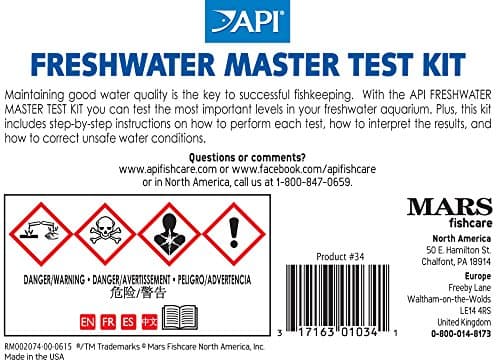
What surprised me was the shelf life question. I had not paid close attention to the "use within 6 months of opening" guidance until I noticed one of my ammonia readings behaving oddly — slightly inconsistent compared to a backup strip I ran as a cross-check. Lesson learned. Now I write the opening date on each bottle with a Sharpie. It is a small step that takes two seconds but keeps your data honest.
Who Should Buy It?
The API Freshwater Master Test Kit is essential for anyone who keeps a freshwater aquarium — full stop. More specifically, it is a particularly strong fit for beginners who are still learning what a nitrogen cycle actually looks like in real numbers rather than textbook diagrams. Watching your ammonia drop to zero, your nitrite follow it, and your nitrates settle into a predictable range is the most satisfying confirmation that your tank is cycled and stable. It also suits experienced hobbyists who want a reliable daily driver for weekly water checks. The 800-test capacity means you are not rationing strips or treating testing as a special occasion. If you maintain multiple tanks, buy two — the cost per test is still microscopic compared to the price of replacing fish.
Skip this kit if you keep only a saltwater reef tank, as the parameters and calibration are freshwater-specific. It is also overkill for someone running a permanently sealed, self-contained bowl with no live fish — say, a planted terrarium or a shrimp-only setup that you completely disassemble and rebuild rather than maintaining long-term. And if you are already paying for automated electronic pH monitors that log data continuously, you probably do not need the manual kit for that parameter alone.
Alternatives Worth Considering
If the API kit is temporarily out of stock or you want a different brand, here are two solid alternatives worth knowing about:
Seachem MultiTest Freshwater Master Kit — Seachem takes a slightly different approach with its multi-test format, bundling pH, ammonia, nitrite and nitrate into a single test suite with a comparator block instead of tubes. Some aquarists prefer the comparator's objectivity over manual color matching. It runs fewer total tests per dollar but is widely respected for reagent accuracy.
Fluval Plant and Reef Pro Kit — If your needs extend beyond the five API parameters, Fluval's offering covers a broader range including phosphate and iron — particularly useful for heavily planted tanks. It is priced higher, but the broader parameter coverage makes it worthwhile for aquascapers monitoring nutrient dosing precisely.
FAQ
The kit provides 800 tests total across all five parameters. That works out to roughly 160 tests per parameter. For a single tank tested weekly, most people find they get 6–8 months of use before needing a replacement.
Final Verdict
The API Freshwater Master Test Kit earns its reputation as the default recommendation for freshwater aquarium water testing. It is accurate enough for serious hobbyists, simple enough for genuine beginners, and affordable enough that cost is never an excuse to skip a weekly check. My one piece of advice: date each bottle when you open it, store reagents away from light, and treat the five-minute wait as a ritual rather than a chore — it gives you a reason to sit quietly by your tank and actually look at your fish for a change.