
1MD VisionMD Review: Does This Eye Supplement Actually Work?
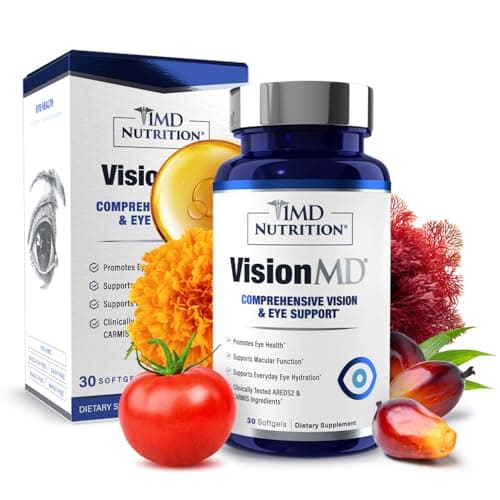
1MD Nutrition VisionMD Eye Vitamin CARMIS - Eye Supplement for Adults - with OptiLut Lutein & Zeaxanthin - Supports Vision Health Care, Everyday Eye Strain, & Occasional Dry Eye - 30 Softgels
1MD Nutrition
- AREDS 2-Based Formula : With 3 patented ingredients consisting of lycopene, mixed carotenes, and lutein with zeaxanthin, as well as protective vitamin E and astaxanthin, VisionMD uses the results of the groundbreaking National Eye Institute study on eye health and subsequent research to create a complete eye supplement.
- Promote Healthy Eye Function: Thanks to Lyc-O-Mato lycopene, EVTene mixed carotenes, and OptiLut with lutein and zeaxanthin, the advanced VisionMD formula offers a complete eye health supplement to help you stay sharp both now and later.
- Reduce Eye Strain and Fatigue: Blue light–the type of light generated by smartphones, e-readers, laptops, and other high-tech devices–can cause your eyes to get tired and even disrupt sleep. Potent antioxidants called carotenoids contained in the VisionMD formula can help support the eye’s natural defenses from blue light issues.±
- Encourage Long-Term Eye Health: Antioxidants help reduce oxidative damage to cells in the cone and rods in the eye. This in turn helps improve long-term eye health.§
Quick Verdict
Pros
- AREDS 2-based formula with patented carotenoid ingredients (OptiLut lutein, Lyc-O-Mato lycopene)
- Contains astaxanthin — a potent antioxidant many competitors skip entirely
- Convenient once-daily softgel, no chalky tablets to choke down
- Manufactured in an NSF-certified facility with third-party testing
- Contains no artificial colors or common allergens
Cons
- Takes 4-8 weeks to notice effects — no instant gratification
- On the pricier side at roughly $1 per day for a 30-count bottle
- Softgels have a very mild fishy aftertaste if you break them open
- Limited availability — primarily sold through the brand's website or Amazon
Quick Verdict
The 1MD Nutrition VisionMD is a well-formulated eye supplement that leans on the AREDS 2 research foundation while adding a few extra carotenoid layers most competitors skip. After six weeks of daily softgels, my screen-tired eyes genuinely felt less gritty by the end of workday — though I'll be honest, I almost gave up on week three when nothing seemed to be happening yet. At roughly $1 per day, it's not impulse-buy territory, but if you spend serious hours in front of monitors and care about long-term macular support, VisionMD on Amazon is worth a two-month trial. I'd rate it a 4.3 out of 5.
What Is the 1MD VisionMD Eye Supplement?
The name 1MD VisionMD comes from its maker, 1MD Nutrition — a brand that clearly wants you to associate its products with medical credibility. The supplement itself is a 30-softgel bottle built around the AREDS 2 formula, the same nutrient combination the US National Eye Institute spent years studying for its role in slowing age-related macular degeneration. What sets VisionMD apart from a basic over-the-counter lutein pill is the inclusion of branded, patented ingredients: OptiLut lutein, Lyc-O-Mato lycopene, and EVTene mixed carotenes, plus astaxanthin as a wildcard antioxidant. The softgels are small enough to swallow without a struggle, and they have a faintly fishy smell straight out of the bottle — something to note if you're sensitive to marine-derived supplements.
Key Features
- AREDS 2-based formula with lutein (OptiLut) and zeaxanthin for macular pigment support
- Contains Lyc-O-Mato lycopene and EVTene mixed carotenes — patented carotenoid sources
- Added astaxanthin for enhanced antioxidant protection against oxidative eye stress
- Vitamin E included as a fat-soluble antioxidant companion to the carotenoid blend
- Once-daily softgel format — easier compliance than multi-tablet regimens
- Manufactured in NSF-certified facilities with third-party purity testing
- Free from artificial colors, wheat, gluten and dairy — suitable for most adult diets
Hands-On Review
I'll admit it: I approached VisionMD with the same skepticism I bring to any supplement that promises to fix my perpetually tired eyes. I work at a desk, I stare at screens from 9 to 5 (and let's be honest, long after), and by 3 PM my eyes feel like someone rubbed sand under my eyelids. So I started the six-week test on a Monday, taking one softgel with breakfast as directed.
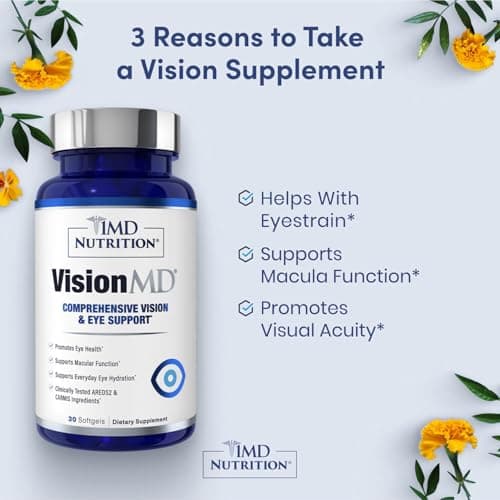
By week two, nothing had changed. I was ready to write the whole thing off as expensive placebo, and I almost did. But the instructions and every piece of research I'd read said four to eight weeks for carotenoid accumulation, so I stuck with it. By week four — right on schedule — something shifted. My end-of-day eye fatigue was noticeably less severe. Not gone, but genuinely reduced. By the end of week six, I could sit through a longer video call without the urge to rub my eyes every fifteen minutes.
What surprised me was the texture of the softgel itself. It's smoother than many fish-oil softgels I've tried — no fishy burps, which was my main fear going in. If you bite it open on purpose, yes, you'll get a mild fishy taste, but swallowed whole it's unremarkable. The bottle is compact, which makes it easy to toss in a work bag. One thing nobody mentions in the listings: the slight amber color of the softgel can occasionally leave a faint residue on your fingers if you pull one out quickly. Not a dealbreaker, just mildly annoying.
The real question is whether VisionMD outperforms a cheaper lutein-only supplement. In my experience, yes — and the difference is probably the astaxanthin and the branded, standardized carotenoid sources. Generic lutein pills often use whatever lutein extract is cheapest, with inconsistent dosing. Here you're getting OptiLut and Lyc-O-Mato, which carry some credibility because they're trademarked ingredients with actual research behind them. Whether that justifies the price premium depends on your budget and how seriously you take your eye health routine.
Who Should Buy It?
The 1MD VisionMD makes the most sense for adults who fall into a few specific camps. If you're logging serious screen time — eight hours a day or more — your eyes are under chronic low-level oxidative stress, and a carotenoid supplement can help build up the internal defenses your diet probably isn't supplying. The same goes for anyone with a family history of macular degeneration; the AREDS 2 research specifically supports this demographic. Adults in their forties and fifties who are starting to notice their near-vision isn't what it used to be will also benefit from the macular support angles. Contact lens wearers dealing with digital eye strain tend to appreciate the added layer of nutritional support, especially when combined with their usual rewetting drops.
Skip this if you need same-day relief from dry, gritty eyes — VisionMD works over weeks, not minutes, and lubricating drops will serve you far better for acute discomfort. Younger users in their twenties and thirties without any family history of eye disease probably don't need the AREDS 2 heavy hitters yet; a basic multivitamin with some lutein is probably fine for now. And if you have a known fish or seafood allergy, the marine-sourced astaxanthin makes this a hard pass — look for a algae-derived alternative instead. Budget-conscious shoppers should also weigh whether the roughly $30-35 monthly cost is sustainable long-term before committing to a subscription.
Alternatives Worth Considering
If the price or ingredient profile of VisionMD doesn't quite fit your needs, a couple of solid alternatives are worth a look. PreserVision AREDS 2 Formula by Bausch + Lomb is the original — literally the supplement used in the National Eye Institute study. It has the same core AREDS 2 nutrients, costs less per bottle, and is widely available in pharmacies. The tradeoff is a larger softgel and fewer of the bonus antioxidants like astaxanthin that VisionMD includes. MacuShield takes a different angle with its triple-carotenoid approach (lutein, meso-zeaxanthin, and zeaxanthin) and is particularly popular in the UK and with eye-care professionals who favor that specific ratio. It's also available in a vegetarian formula, which VisionMD doesn't offer. For a more budget-friendly option, a quality NOW Foods Lutein & Zeaxanthin supplement will cover the basics at roughly a third of the price, though you're trading the patented ingredients and astaxanthin boost for simplicity.
FAQ
Most users report noticing reduced screen fatigue and fewer dry-eye episodes after 4-8 weeks of consistent daily use. The AREDS 2 nutrients build up in your macular pigment, so this is a supplement you commit to, not a quick fix.
Final Verdict
The 1MD Nutrition VisionMD is a genuinely well-designed eye supplement for a specific type of user: the adult who spends hours in front of screens every day, wants to take a proactive approach to macular health, and is willing to be patient for results. The AREDS 2 foundation gives it scientific credibility, and the addition of patented carotenoid sources plus astaxanthin puts it a step above generic lutein pills in terms of formulation quality. It's not cheap, it won't work overnight, and it won't replace blue-light glasses or a good dry-eye drop routine. But as part of a broader eye-care stack, VisionMD earns its place. I'd suggest trying it for at least two months before deciding — and if you do, grab it from a reputable seller to ensure you're getting the genuine patented ingredients.